Friday, August 20, 2010

"O! Tis excellent to have a giant's strength"

This quote from Shakespeare's Measure for Measure, was Vic Tanny's senior quote in the 1935 Saga (the former yearbook of our college.) In a school like ours with such an active physical education program it is good to recall something of Vic Tanny's accomplishments.

First you have to understand that in the 1930s there was little in the way of gyms or health clubs as we know them today. A young man who wanted to work with weights might find himself, like Vic, in his garage, using sandbags tied to broomsticks and other home made equipment!

Although he trained as a junior high teacher, Vic Tanny was passionate about exercise, weight training and body building, and these became his career. His greatest accomplishment was to be a pioneer of the modern health club movement.

He opened his first gym shortly after WWII in Santa Monica, near the original "Muscle Beach." It was the 7,000 square foot basement of a USO club, and became fondly known as "The Dungeon." It was the place to train for weightlifters and body builders in the 1940s and 1950s. Members included actor Steve Reeves and Joe Gold, who went on to establish the famous Gold's Gym.

From this beginning Vic established a chain of clubs, moving away from the "dungeon" model to one where more ordinary men and women might feel at home. Among other things he pioneered the idea of paying membership fees by installment, making membership more workable for people.

Although in later years financial problems led to his chain of clubs being sold, mostly to Bally's, Vic Tanny '35 remains to this day a respected figure in the history of physical training and health clubs. (Pictured here is Vic in the one of his clubs in the early 1960s.)

Friday, July 30, 2010

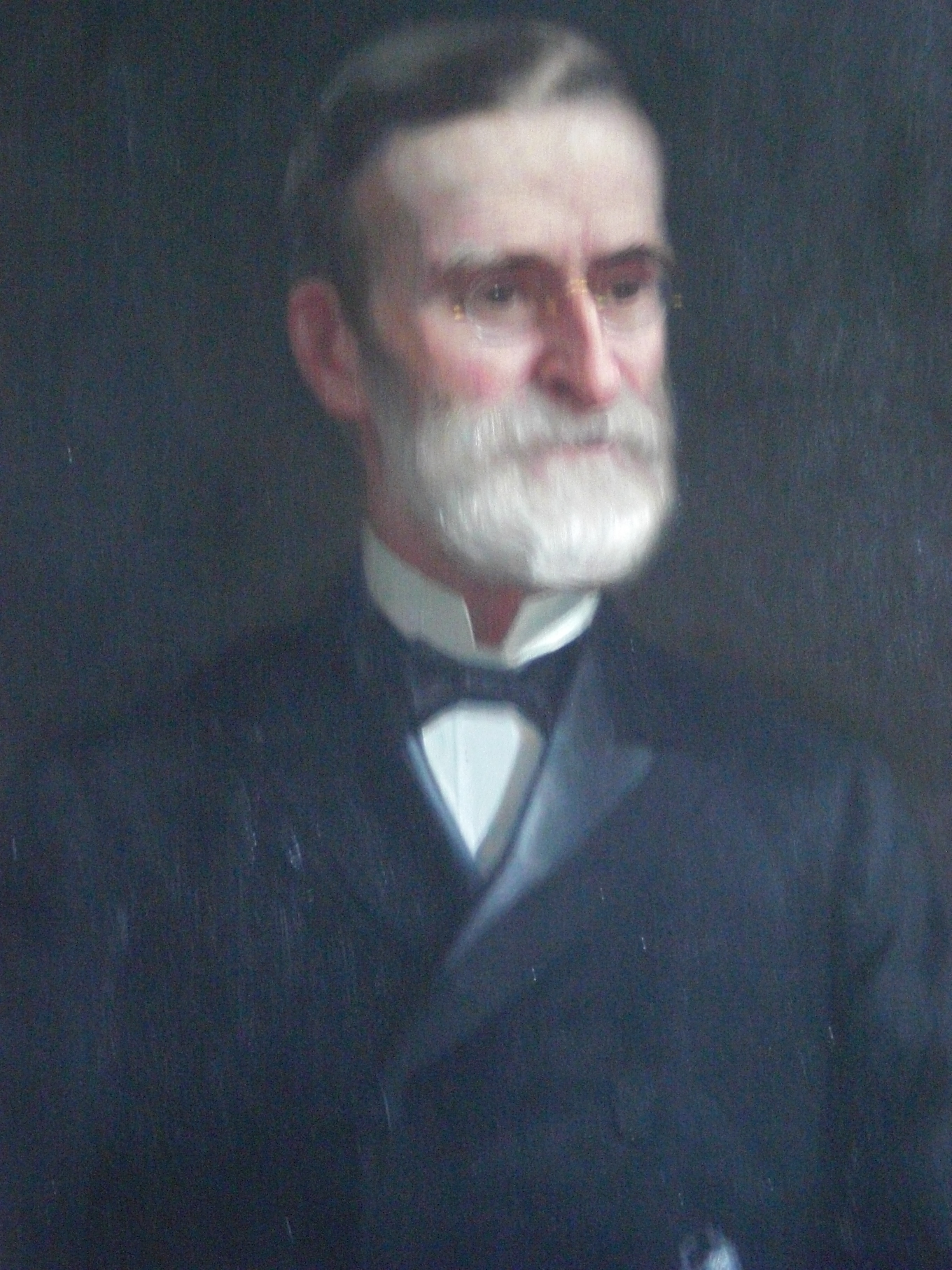
Malcolm MacVicar

Yes, MacVicar, as in MacVicar Hall, one of our residence halls. He was "principal," that is president, of our school 1858-1868. This was a key transitional period for the school, where we went from being a private "collegiate institute" to being a state "Normal School."

MacVicar was a Scottish immigrant to Canada and came to this country as a teenager to work as a ship's carpenter, but discovered a calling to preach and became a Baptist minister.  He found though that his real calling was in education, and he was a capable and astute educator, leading Brockport through some difficult times, where as a private school we were in real financial difficulties, to a secure place as a state supported school.

He then went on from Brockport to run Potsdam, and later several other colleges. Subsequently he was involved in higher education for blacks in the American post Civil War south. As superintendent of the American Baptist Home Mission Society, he oversaw the operations of a seminary, seven colleges, and a number of academies across the south.

MacVicar finished his career as president of the newly formed Union University in Virginia, which is today Virginia Union University - and they also have a residence hall named after MacVicar!

Thursday, July 15, 2010

Our school, from an early catalog

[caption id="attachment_13" align="aligncenter" width="470" caption="The Brockport Collegiate Institute in 1842"][/caption]

Thursday, July 8, 2010

1835 - 2010!

From  "Academy" to "Normal School" to "Teachers College," and on to today's comprehensive school, it has been a long and rather intriguing road. Many of us enjoy reading about dramatic historical events and periods, wars, revolutions etc., yet how many of us actually ever take part in such things? On the other hand, we all go to school, and yet most people know little about how education, especially higher education, has developed and grown in this country.

Here's a (greatly!) simplified overview:  in 1835 public schooling covered grades  1-8, and there was no high school as we know it. Colleges, schools that granted the bachelor degree or higher, were extremely few in number, expensive, and generally for men only. They also tended to focus on a classical curriculum, Greek, Latin, rhetoric etc.

As the country expanded, the perception grew that more educational opportunity for its citizens was needed. People wanted better trained teachers for grades 1-8,  higher education that included more science and practical subjects, and schools more accessible to ordinary people.

This led to the development of the "academies," an early educational form that combined elements  of both today's high schools and colleges. Such a school was started here in Brockport in 1835, on land donated by Hiel Brockway, founder of Brockport. The six acres he donated are still part of the campus, the area where Hartwell Hall is now. The original building was in the same general location as Hartwell, as were subsequent buildings. (Hartwell Hall followed these earlier buildings in the late 1930s.)

So ends this initial history lesson :-) Please follow this blog over the coming year as we explore the many facets of our school's history!